

Our new book: Agentic Large Language Models
Published:
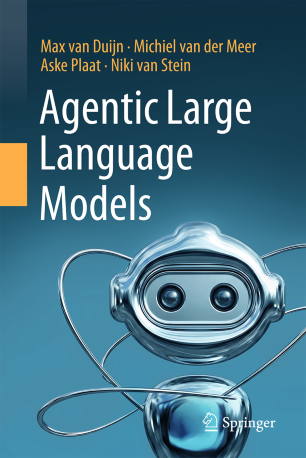
Some projects take longer than you expect. This one took a year and a half. Together with Max van Duijn, Michiel van der Meer and Aske Plaat, I have written a textbook: Agentic Large Language Models. The full text (472 pages) is now available on arXiv, and the Springer edition is coming soon.
Why we wrote it
Large language models have become very good at talking with us: they answer questions, help us write, and reason about the world. Their answers already shape the decisions people make. The next step is already happening: LLMs that do not only talk, but act. They search, call tools, write and run code, and work together with other models. We call these systems agentic LLMs: a language model plus a harness that gives it memory, tools and a way to observe what its actions do.
When we started, there was no single place where a student could learn how these systems work from the ground up. There were thousands of papers, blog posts and model cards, and very little that connected them. So we decided to write the book we wanted to teach from.
What is in the book
The book follows three questions: how agentic LLMs reason, how they act, and how they interact.
- It starts with the foundations: how language models are trained, why scaling works, and how to make models efficient.
- It then covers reasoning: chain-of-thought, self-reflection, world models and metalearning.
- The middle of the book is about acting: retrieval, tool use, and assistants in medicine, finance and science.
- The last parts look at interaction and behaviour: multi-agent systems, role-based collaboration, and the emergent behaviour of simulated societies of LLM agents.
- Advanced chapters cover synthetic data, mechanistic interpretability for LLM agents, and cognitive perspectives.
Writing it with four authors from different backgrounds (computer science, cognitive science, natural language processing and AI) was one of the best parts. Every chapter was read and argued over by people who look at LLMs in very different ways, and I think the book is better for it.
A book that keeps moving
The hardest part of writing about agentic LLMs is that the field does not stand still. A chapter that is complete today can miss an important development a few months later. We have accepted that, and turned it into a plan: we aim to update the book on a yearly schedule, so that it stays a useful starting point rather than a snapshot of one moment.
The course
The book did not come out of nowhere: it grew together with a new master course at LIACS, also called Agentic Large Language Models, which the four of us teach this fall. Students follow the parts of the book and work on four hands-on Python case studies, from building an LLM from scratch to simulating societies of LLM agents. Every yearly update of the book will feed into the course as well, so students always learn from current material.
Everything about the book and the course (the syllabus, the schedule and the announcements) is collected on our website: agenticllms.liacs.nl.
Thank you
A year and a half is a long time to spend on one project next to research, supervision and teaching. Thank you to my co-authors Max, Michiel and Aske for the many discussions, and to everyone who read drafts and sent comments. If you use the book, in a course or on your own, I would love to hear what you think, and what should be in next year’s edition.
Links
- Book preprint on arXiv: arXiv:2610.13455
- Springer edition (coming soon): link.springer.com/book/9789819256587
- Book and course website: agenticllms.liacs.nl
- The master course on this site: Agentic Large Language Models